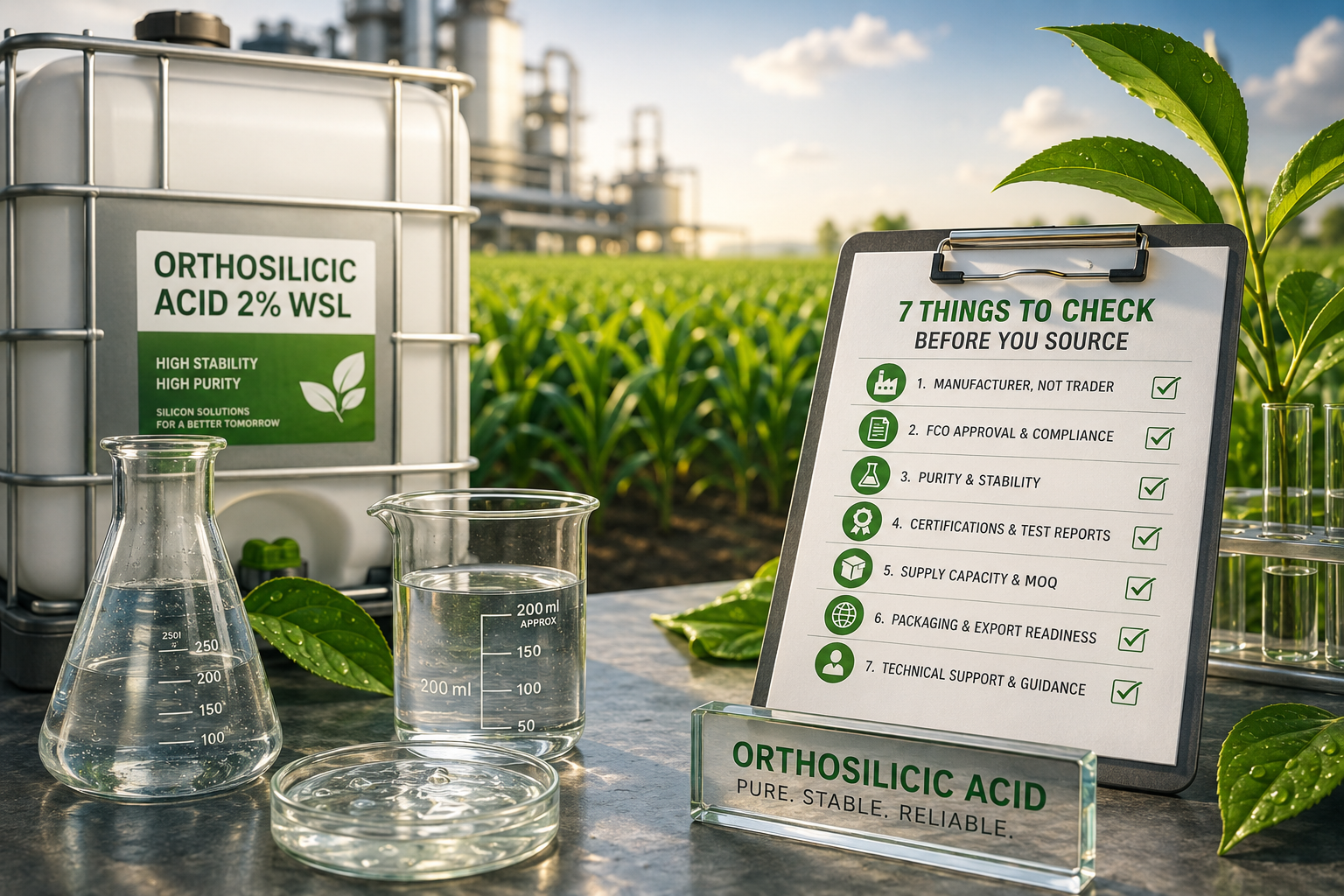
The Silicon Toolkit for Modern Crops: Where OSA and Spreaders Each Fit
Silicone vs Silicon in Agriculture and Where Each One Fits
If you've ever ordered a "silicon" product for a formulation and had it arrive doing nothing like what you expected, you're not alone, and it's probably not your fault either.
Two completely different products share that one word. One gets absorbed into the plant and becomes part of its actual structure over time. The other never goes near the inside of the plant at all, it just helps whatever's in the tank spread properly on the way down.
Get them mixed up and you won't find out right away. The batch just quietly underperforms. Three weeks pass, somebody notices, and now you're digging backward through a mistake nobody flagged when it actually happened.
| Quick answer: OSA is the nutrient side of this. Roots and leaves absorb it, and it builds plant strength and stress tolerance from inside. A spreader doesn't do any of that. It stays outside the plant entirely and just drops surface tension, so a spray spreads evenly and actually sticks where it lands instead of running off. Different chemistry. Different jobs. A lot of working formulations use both anyway. |
Silicon and Silicone Aren't the Same Word
We get why people mix these up. The spelling practically invites it. But sit with the chemistry for five minutes and you'll see how different these really are.
Silicon is an element, the same one sitting quietly in sand, in quartz, in most of the mineral content of ordinary soil.
Silicone isn't found in nature. Somebody built it in a lab, silicon and oxygen strung together with organic groups hanging off the backbone, made specifically to act like a surfactant.
This isn't pedantry. Say the wrong one to a supplier and you can genuinely end up with the wrong product on your dock, because one of these is something a plant metabolizes and the other only changes how a liquid behaves on a leaf for the few minutes it takes to do its job.
That's what silicon vs silicone in agriculture actually comes down to once you strip away the confusion.
Why Do Crops Need Silicon At All?
Here's something that trips people up the first time they hear it: soil is full of silicon, and most of a plant growing in that soil still can't use any of it. Most of what's there sits locked up as quartz and aluminosilicate minerals, stable enough that a root can sit beside it for years and never touch a usable fraction.
A field can test high in silicon on paper. The crop growing in it can still be running short. Present in the soil and available to the root turn out to be two separate questions.
Once a plant does get a usable supply, the difference shows up. Rice and wheat take a hard wind and a heavy grain load without lodging over, largely because their cell walls hold up better. Water loss slows down under heat stress.
Leaf surfaces get tougher for piercing insects and fungal spores to break into. That's the real substance behind the benefits of silicon in plants, though how much of it shows up depends a lot on which crop you're growing.
The Nutrient Side of the Toolkit: Orthosilicic Acid
Only one form of silicon is actually small enough and soluble enough for a root or a leaf to pull in directly. It's called orthosilicic acid, H4SiO4 if you want the formula written out.
Everything else, the silicates, the raw silica sitting in soil, needs years of weathering before it breaks down into anything close to this.
Orthosilicic acid for plants skips that wait completely. Once it's absorbed, it moves through the plant and deposits as polymerized silica right into the cell walls. That's the actual mechanism behind the lodging resistance and pest toughness we just talked about.
There's a second role too, one that doesn't get mentioned as often: OSA seems to help a plant hold onto moisture and cell turgidity when temperatures spike past 40°C. That matters more in the field than it sounds like it should on paper.
One setting makes OSA stop being a nice-to-have. Hydroponic and other soilless media carry almost no natural silicon. No weathering is happening in a nutrient tank. No mineral reserve sits around waiting to be accessed someday.
A stabilized liquid silicon fertilizer for plants becomes the only real way to get any silicon into that system at all. Fenton Chemical's Orthosilicic Acid 2% WSL, sold as Fenosil, is built for exactly this kind of foliar and fertigation use.
5 Silicone Spreaders Products For Every Formulator
None of what a nutrient does inside a plant counts for much if the spray carrying it never actually touches the leaf properly. That's a different problem entirely, and it's where a silicone spreader for agriculture comes in.
These are organosilicone surfactants, most of them built on a trisiloxane backbone, and their one job is dropping water's surface tension lower than a conventional surfactant ever could. Fenton Chemical makes five of these.
They're not interchangeable, even if a quick look at a spec sheet makes them seem that way.
FX SPT 500
Formulators build this into the product early, not at spray time. Dosed into SC and EC formulations at 1 to 5%, it's already working before a drop reaches a sprayer. Cuticle penetration is strong.
That makes it a fit for systemic pesticides and fungicides. Anything that needs to get past the leaf surface instead of sitting on it. Dilute in water. Mix well. Store it cool, away from the sun. Heat wears a surfactant down fast.
FX SP 225
Price is the whole story with this one. It won't win on raw performance. Nobody's pretending otherwise. What it delivers is steady droplet spread. Less wastage too.
The cost matters once volume climbs. Every rupee per liter adds up across a season. Mix into water. Run it through standard equipment. That's really it.
FX SP 188
Spreading a droplet is only half the job. Holding it there is the other half. Cheaper spreaders fail at that second part, especially on waxy leaves or in humid air. FX SP 188 was built for that gap. It combines spread with real adhesion.
The droplet stays put through an unstable weather window instead of rolling off. Less runoff follows from that grip. One note from the handling instructions: skip spraying it in high humidity.
FX SP 100
Fast is the entire pitch. The sooner a droplet absorbs into the cuticle, the sooner it starts working. FX SP 100 is built around shrinking that window. Useful when a pest or disease pressure situation won't wait.
Mix it straight into the agrochemical being applied. Covers evenly. One warning in the instructions is easy to miss: going past the recommended rate doesn't help. It just wastes product.
FENSIL 360 (powder format)
Everything above pours. This one doesn't. It's a powder, free flowing, water soluble. Built for dry formulation types like WP, GR, WDG, and SP. A liquid additive has no place in that process.
At 0.1% concentration its surface tension drops to 20.5 mN/m. Low enough to spread faster than most liquid surfactants at a comparable dose.
There's a second use most people don't expect: wetting dry soil. Hydrophobic soil behaves like a dusty windowsill in light rain. Water sits on top instead of soaking through. Pre-emergent herbicides pool where they shouldn't. FENSIL 360 breaks that resistance. It helps moisture stay in the root zone.
It also makes conditions worse for soil fungi and nematodes that favor dry, undisturbed topsoil. Dosage stays small throughout: about 5 grams per 15 liters in a tank mix, 1 to 5% in WP or WDG formulations, 3 to 5% as a dispersing agent.
OSA and a Silicone Spreader Don't Do the Same Job
Line them up and the gap is obvious. OSA gets absorbed. It becomes part of the plant's own structure. That takes weeks, as silicon deposits build up in the tissue.
A spreader never gets absorbed. It works entirely on the outside. Results show up in minutes, not weeks.
A treated droplet spreads fast and starts penetrating stomatal openings almost right away. That's also what gives a tank-mix its rainfastness. Call one nutrition. Call the other logistics.
Better Together: Using Both in the Same Tank
Nobody has to pick one. Adding a spreader to a foliar OSA program solves a real problem. OSA alone can't get the solution to cover both sides of a leaf evenly before it dries. The spreader adds no nutrition of its own. It just makes sure the nutrient actually arrives.
This pairing shows up constantly in silicon based agrochemicals formulation work. Not because the two overlap in function.
Because stacking a nutrient with the right delivery mechanism solves more of the real problem than either one alone. A jar test before scaling up still takes ten minutes. Still worth doing.
Matching the Right Silicon Product to Your Formulation
Start with the actual goal. Building plant resilience over a season, especially in a hydroponic or soilless setup? OSA is the answer. Chasing better coverage, faster uptake, or rainfastness for whatever's in the tank? That's a spreader question. The right grade depends on formulation type and field conditions, exactly as covered above.
Let’s Get the Right Silicon Tool for the Job!
Silicon and silicone were never competing for the same job. They're two tools for two problems. Most strong formulation programs end up using both. Getting the nutrient side right means verifying bioavailable content, not just a percentage on a label. Getting the delivery side right means matching the grade to what the formulation actually has to survive.
Fenton Chemical's technical team can help match a specific formulation to the right grade, with batch documentation and compatibility support included.
FAQs
Are silicon and silicone the same thing used in agriculture?
No. Silicon is the natural element. Silicone is a manufactured polymer built from it. Each serves a completely different purpose in a crop program.
Can OSA and a silicone spreader go in the same tank?
Usually, yes. A spreader is commonly added to a foliar OSA tank-mix to help the solution cover a leaf more evenly. A small jar test is still worth doing first.
How do I know which silicone spreader grade to use?
It depends on formulation type and field conditions. Liquid formulations chasing fast knockdown suit FX SPT 500 or FX SP 100. Dry formulations and soil applications suit FENSIL 360. Difficult weather or waxy leaves call for FX SP 188's adhesion.
More Blogs
View All →
Matte, Gloss, Durable: How Additives Shape Paint Performance

The Adjuvant Mistake That's Costing Farmers Every Spray Cycle

The Farmer's Timing Guide: When OSA Actually Works Best

How to Reduce Foam in Paint: The Hidden Cost of Bad Mixing
Foliar Spray Guide: How to Apply Fenosil OSA for Maximum Uptake

Debunking 5 Common Myths About Silicon Fertilizers in Agriculture
OSA for Rice Cultivation: A Season by Season Application Guide