The Future of Agro Emulsifiers in Industrial Chemistry
The Future of Agro Emulsifiers in Industrial Chemistry
Introduction
For a long time, agrochemical companies focused mostly on active ingredients. If the chemical was strong enough, the product was expected to work. But that thinking has changed quite a bit over the years.
Now the bigger issue is formulation performance.
A product may contain effective active ingredients and still underperform in actual farming conditions. Sometimes it separates during storage. Sometimes spray coverage becomes uneven. In other cases, the formulation simply doesn’t stay stable long enough after dilution. These are practical problems, and they affect product performance more than people realize.
That’s exactly why selecting the right agro emulsifiers have become more important in modern industrial chemistry. They help improve stability, consistency, and application quality across different agricultural products. And as formulation science keeps evolving, manufacturers are starting to invest much more into smarter emulsifier systems rather than relying only on stronger chemicals.
What Are Agro Emulsifiers?
Agro emulsifiers are materials used to improve the compatibility and dispersion of different ingredients within a formulation, helping them stay uniformly distributed and perform effectively throughout the application process. Since many agrochemical ingredients require the support of surfactants or carrier systems to become properly soluble or dispersible in water, emulsifiers play an important role in maintaining formulation consistency, stability, and overall performance.
Why Emulsifiers Matter in Modern Agrochemicals
Agricultural formulations today are expected to perform under very different conditions. That creates pressure on formulation quality.
Another important factor is surface coverage. Certain surfactants in agriculture improve how formulations interact with plant surfaces, which can directly affect absorption and treatment efficiency.
There’s also the issue of compatibility now. Modern crop protection formulations often combine multiple ingredients together, and maintaining stable mixtures is not always easy. Emulsion stability in agrochemicals has become a bigger technical concern because of that.
The Limitations of Traditional Emulsifiers
Older emulsifier systems still have industrial value, but they don’t always meet the demands of newer formulations.
Some traditional systems struggle under heat or long-term storage conditions. Others may not perform well with advanced active ingredients used in current industrial emulsifier applications. Inconsistent stability can eventually affect product quality, especially at larger production scales.
That shift is happening gradually, but it’s definitely happening.
The Future of Agro Emulsifiers
The future of agro emulsifiers in industrial chemistry is moving toward better performance with lower environmental impact. That seems to be the direction most formulation research is taking right now.
A lot of attention is going toward sustainable agro emulsifier technologies, especially systems that improve biodegradability without reducing formulation efficiency. Bio-based emulsifiers in agriculture are becoming part of that conversation because they’re derived from renewable sources and are generally considered more environmentally compatible.
At the same time, companies are trying to improve formulation precision. They want products that remain stable longer, perform consistently across conditions, and require lower chemical usage overall.
The role of emulsifiers in agrochemical formulations is no longer limited to simple mixing support anymore. They’re becoming part of the overall strategy behind product performance and formulation design.
Industrial Impact & Applications
The demand for high-performance agro emulsifiers has increased across multiple agricultural sectors. They’re now widely used in pesticide formulations, liquid fertilizers, suspension concentrates, and specialty treatment products.
Industrial emulsifier applications are also expanding as precision agriculture becomes more common. Formulations now need to meet higher expectations around stability, spray efficiency, and consistency.
For manufacturers, even small formulation improvements can affect large-scale operational performance. That’s one reason emulsifier selection has become much more technical than before.
Choosing the Right Emulsifier
There’s no universal emulsifier solution for every agrochemical product. Different formulations require different performance characteristics depending on storage conditions, ingredient combinations, and application methods.
A well-selected emulsifier can improve shelf stability, dispersion quality, and overall product reliability. Poor selection usually creates problems later, either during production or actual field application.
That’s why companies spend more time testing agricultural emulsifier solutions during formulation development now.
Why Expertise Matters
Formulation chemistry is becoming more specialized every year. Companies are not only trying to improve product performance, they’re also trying to meet regulatory standards and sustainability goals at the same time.
Conclusion
Agrochemical science is moving fast. We’ve seen a five-year shift where the focus has expanded beyond just the active ingredients to the “hero” formula: the emulsifier. Today’s market demands more than just a functional chemical.
It requires solutions that offer enhanced stability and sustainable footprints.
More Blogs
View All →
Foliar Spray Guide: How to Apply Fenosil OSA for Maximum Uptake
Introduction
Farmers spray Fenosil exactly as instructed and still call asking why nothing changed. 90% of the time, the dosage was right. But, the problem was somewhere else in the process.
That's the thing about foliar spray orthosilicic acid programs: the dose on the label is only one variable. Miss the leaf underside, spray under the wrong conditions, skip the wetting agent, and most of that silicon never gets past the leaf cuticle.
This OSA foliar application guide walks through what actually determines whether Fenosil works the way it's supposed to.
Why Foliar Application Works for OSA?
Here's the mechanic behind it. Soil silicon mostly sits in forms roots can't touch, silica, silicates, mineral-bound stuff that takes years to weather down. A plant standing in silicon-rich soil can still be silicon-starved. Spraying skips that problem entirely.
Fenosil already carries silicon as orthosilicic acid (Si(OH)₄), the bioavailable form of silicon that plants can absorb through their leaves. This is why foliar application can be an effective way to deliver silicon directly to the plant. For a deeper explanation, see our guide to the bioavailable form of silicon for plants.
What Makes Fenosil OSA Spray Ready?
A lot of what's sold as OSA is really just silica hoping to convert once it hits the tank. Fenosil skips that gamble, manufactured stable at 2% Orthosilicic Acid WSL so it's still bioavailable when it lands on the leaf, not just when it leaves the factory.
| Parameter | Standard | Fenosil |
| Orthosilicic Acid (Si(OH)₄), min | 2.0% | 2.5% |
| Plant-available silicon, min | 0.6% | 0.8% |
| pH (1% solution, 20°C) | 1.7–2.2 | 1.9–2.1 |
Base orthosilicic acid dosage per litre is 1 to 2 ml Fenosil per litre of water. That number is what the rest of this guide builds on.
Before You Fill the Tank
Preparation decides whether that dosage even reaches the leaf in the first place.
- Pre-dilute Fenosil in a small volume of water before adding it to the main tank.
- Add a wetting agent with silicon spray mixes, preferably non-ionic, so the droplet spreads instead of beading on waxy leaves.
- Run a jar test before tank-mixing with pesticides. Fenosil suits most, but clashes happen.
- Use clean water. Hard or dirty water interferes with even spreading.
Mistakes Quietly Wasting Your Spray Tank
A few common application mistakes can limit the effectiveness of a foliar silicon program. Here’s how to apply orthosilicic acid correctly:
- Spraying only the top of the leaf can reduce uptake. For better coverage, silicon spray both sides of leaves whenever possible.
- Apply during active leaf growth. Older, hardened leaves tend to absorb less silicon.
- Use a wetting agent to help the spray spread evenly across the leaf surface.
- Avoid spraying during hot afternoons or when rain is expected within a few hours.
Best Window in the Crop Cycle to Start
The best time to spray orthosilicic acid comes down to a simpler answer than most expect.
Spray while new leaves are still forming, or while the whole plant is young. Older cuticles resist uptake, so timing matters more here than people assume. This is real OSA spray for new leaves territory.
- Morning or evening, not midday. Cooler leaf temperature stops the solution from flash-drying.
- Foliar silicon application interval: 10 to 14 days, across 4 to 6 weeks.
- Short-duration crops: 2 sprays. Mango, grapes, and other trees: 4 sprays, timed after pruning.
What Results Actually Look Like, and When?
Don't expect visible change after one spray. Silicon builds into plant structure over time, not in a single reaction. For a deeper look at the benefits of Orthosilicic Acid 2% WSL, you can explore Fenton Chemical's detailed guide.
First 2 to 3 weeks: firmer leaves, a shade deeper green, less wilting at midday.
By 4 to 6 weeks: better resistance to pest and fungal pressure, stronger stems, and in fruiting crops, noticeably better fruit size and color.
Let’s Make Every Fenosil Application Count
With foliar silicon, application matters as much as the product itself. The right spray timing and a properly prepared tank mix can make a noticeable difference in the results you see in the field.
Planning a spray program this season? Fenton Chemical's team can help with crop-specific dosage recommendations and provide the TDS, dosage guide, and a trial sample of Fenosil OSA. Get in touch for pricing and bulk availability.
Frequently Asked Questions:
Can Fenosil be mixed with pesticides?
Usually, yes. Still, jar-test the mix first. Takes five minutes and saves you from a ruined batch.
How soon will I see results?
Not immediately, so don't judge it after one spray. Leaves firm up within two to three weeks. Stress and disease resistance, the real payoff, builds in closer to four to six weeks.
Does it work on all crops?
Broadly, yes, across rice, sugarcane, wheat, tomatoes, grapes, and potatoes among others. Trees and long-season crops need a different spray count than short-duration ones.

Debunking 5 Common Myths About Silicon Fertilizers in Agriculture
Introduction
Not every farming discussion ends with an answer. Ask about silicon fertilizers and someone will usually have a success story. Someone else will remember a disappointing season instead. The next conversation often sounds a little different again.
That's why silicon fertilizer myths never really disappear, and why silicon fertilizer facts vs myths still get mixed up today.
Why Silicon Fertilizer Myths Persist in Agriculture
Most farming advice has a story behind it. Someone tried a product once. Someone else followed a recommendation that worked well in a different crop. Before long, those experiences begin travelling from one farm to another.
What often gets left behind is the context. The source of silicon changes. The crop changes. The timing changes.
Even so, the advice usually stays exactly the same. That's one reason conversations around silicon nutrition agriculture can sound so different from one grower to the next.
Myth 1: All Silicon Fertilizers Work the Same Way
The Reality: It's easy to assume every silicon fertilizer works the same way. After all, if each product claims to supply silicon, the results should be similar.
The difference begins with the form of silicon itself. Plants can absorb silicon only when it's in bioavailable form.
Stabilized orthosilicic acid (OSA) is readily taken up by the plant, while products that contain silica or silicates may not provide silicon in the same way.
Most bioavailable silicon myths begin when every silicon source is expected to behave the same inside the plant. That's why the silicon source tells you much more than the percentage printed on the label, and why OSA vs silica myths continue to create confusion.
What ultimately matters is whether the crop can actually absorb and use it.
Myth 2: Silicon Is Only Useful for Cereal Crops
The Reality: The belief comes from where silicon research first gained attention. Rice and wheat showed the clearest response because they naturally accumulate more silicon, so they became the focus of early studies.
That doesn't mean other crops are left out. Fruits, vegetables, plantation, and cash crops can also benefit from stronger plant structure, better stress tolerance, and improved produce quality when supplied with plant-available silicon, such as orthosilicic acid.
Myth 3: More Silicon Application Always Means Better Results
The reality: It's a common assumption with many farm inputs: if a little helps, more should help even more.
Silicon doesn't work that way. Once the crop receives what it can effectively use, increasing the dosage won't necessarily improve results and may even affect the balance of nutrients like zinc or phosphorus.
In practice, the biggest gains come from applying the right amount at the right stage, allowing crops to fully benefit from orthosilicic acid (OSA) rather than simply applying more.
Myth 4: Silicon Fertilizers Can't Be Mixed With Pesticides
The Reality: One unsuccessful tank mix is often enough for someone to decide that silicon fertilizers don't mix well with anything else. The story then gets passed around long before anyone asks what was actually in the spray tank.
In many cases, the issue isn't silicon itself. It comes down to the formulation and the products being mixed together.
A quick jar test before spraying usually answers that question better than guesswork, and a well-formulated orthosilicic acid (OSA) product often makes tank mixing more dependable.
Myth 5: You'll See Results Immediately After One Spray
The Reality: Many growers expect to notice a difference after the first spray. That's understandable, and it's one reason people still ask, does silicon fertilizer really work? But, silicon doesn't work like a quick stimulant.
Its role begins only after the plant absorbs it. As silicon gradually becomes part of the plant's tissues, it helps strengthen cell walls from within.
That's why the biggest changes aren't usually immediate. Better stress tolerance, improved disease resilience, and stronger overall crop performance tend to develop over a consistent application programme. The benefits of orthosilicic acid (OSA) become much more noticeable as the crop grows, not after a single spray.
What Farmers Should Actually Focus On Instead of Myths
The discussion doesn't have to begin with the myths. It can begin with a few practical questions.
Is the silicon in a plant-available form? Does it suit your crop and its current growth stage? Are you following the recommended application programme?
Those answers usually have a much greater influence on field performance than the myths surrounding silicon fertilizers. That's where the silicon fertilizer benefits truth becomes much clearer.
Conclusion: Separating Fact From Fiction in Silicon Nutrition
Once the crop is in the field, the conversation slowly changes. Growers spend less time debating silicon fertilizers and more time comparing what actually worked. That's often where silicon fertilizer facts vs myths become easier to separate.
The source of silicon, the timing of the application, and the quality of the formulation usually explain far more than the stories passed around during the season.
The same goes for choosing an orthosilicic acid (OSA) manufacturer.
OSA for Rice Cultivation: A Season by Season Application Guide
Introduction
Walk through two neighbouring rice fields at harvest, and the difference is often easy to spot. One remains standing with well-filled panicles, while the other begins to lodge before the season ends.
That difference rarely starts at harvest. It develops much earlier as the crop builds its roots, stems, and leaves. That's why orthosilicic acid for rice works best as a season-long nutrition strategy.
This guide explains how OSA rice cultivation changes from one growth stage to the next.
Why Rice Needs Silicon More Than You Think
Rice has a habit that many other crops don't. It keeps taking in silicon as it grows. Little by little, that silicon becomes part of the plant itself, especially the leaves and stems. That's the reason rice is known as a silicon accumulator crop.
The plant does have one requirement. It can only use silicon after it becomes orthosilicic acid for plants. Without that soluble form, even a field that contains silicon may not supply enough for the crop when demand begins to rise.
The Complete OSA Application Timeline for Rice
Knowing that rice keeps taking up silicon is only one part of the story. The timing matters just as much. The plant doesn't need the same level of support from transplanting to harvest because its priorities keep changing as it grows.
That's why a fixed spray schedule rarely works for every field. A better OSA application schedule follows the crop itself. Each stage has a different purpose, and the role of a silicon fertilizer for rice changes along with it.
A. Nursery Stage: Building Strong Roots Early
A rice seedling doesn't have much room for error after transplanting. It either settles into the soil or spends the next several days trying to recover.
That's why many growers begin with OSA for seedlings instead of waiting for visible growth. This early silicon application gives young roots a better start, helping the crop establish itself before the season begins demanding more from it.
B. Tillering Stage: Where Stem Strength Begins
A rice plant begins shaping its future long before heavy panicles appear. Every healthy tiller adds to the crop's final yield, but it also needs the strength to support that weight later. This is where silicon for lodging resistance becomes important.
Many growers continue with orthosilicic acid tillering because the stems are still developing, even if the field already looks healthy.
C. Panicle Initiation: Setting Up for Grain Quality
By the time panicles begin forming, the crop has stopped thinking only about growing taller. Its attention shifts toward producing grain.
At this point, silicon plant nutrient support helps the plant manage that transition with less stress. Many growers continue OSA panicle stage applications because the harvest ahead is already taking shape, even if it isn't visible yet.
D. Flowering and Grain Filling: Locking in Yield
Once flowering is over, the crop isn't trying to produce more grain. It's trying to fill what it has already set.
Healthy leaves and strong stems keep that process moving, especially when the weather becomes less predictable. These are some of the orthosilicic acid yield benefits growers look for as the crop moves closer to harvest.
E. Pre-Harvest: Preventing Last-Minute Lodging
Some rice fields stay upright until harvest. Others begin leaning only a few days before the combine arrives. The difference often becomes clear when the panicles grow heavier.
That's why growers look for ways to reduce lodging in rice before the season ends. Good stem strength also adds another layer of silicon crop protection when the crop is carrying its maximum weight.
Foliar Spray or Soil Application: What Works Best in Paddy Fields?
Some situations call for a quicker response. Others reward patience. An OSA foliar spray fits those moments when the crop needs silicon without waiting. A silicon soil application rice programme stays available for longer, supporting the crop as it continues to grow.
That is why many growers rely on both rather than choosing only one.
Mistakes That Reduce OSA Effectiveness in Rice
Good results rarely depend on one spray alone. Many orthosilicic acid application mistakes happen when growers apply it too late or expect one treatment to support the entire season.
Formulation quality matters too. If the silicon isn't stable, the crop can't benefit from it the way you expect.
What Results to Expect and When
The first changes are usually easy to miss. A stronger crop often reveals itself little by little as the season moves forward. That's the orthosilicic acid results timeline growers should expect.
Better establishment comes first, followed by stronger stems and a crop that stays standing more confidently as harvest gets closer.
Conclusion: Building a Silicon Strategy for Your Rice Crop
Every rice season teaches something different, but one lesson stays the same. The crop responds better when silicon is available throughout its growth, not only after problems appear.
Choosing the right orthosilicic acid manufacturer is part of that approach because formulation quality matters as much as timing. When you finally buy OSA for rice, you're choosing a season-long strategy, not just another field application.
Orthosilicic Acid Manufacturer in India: 7 Things to Check Before You Source
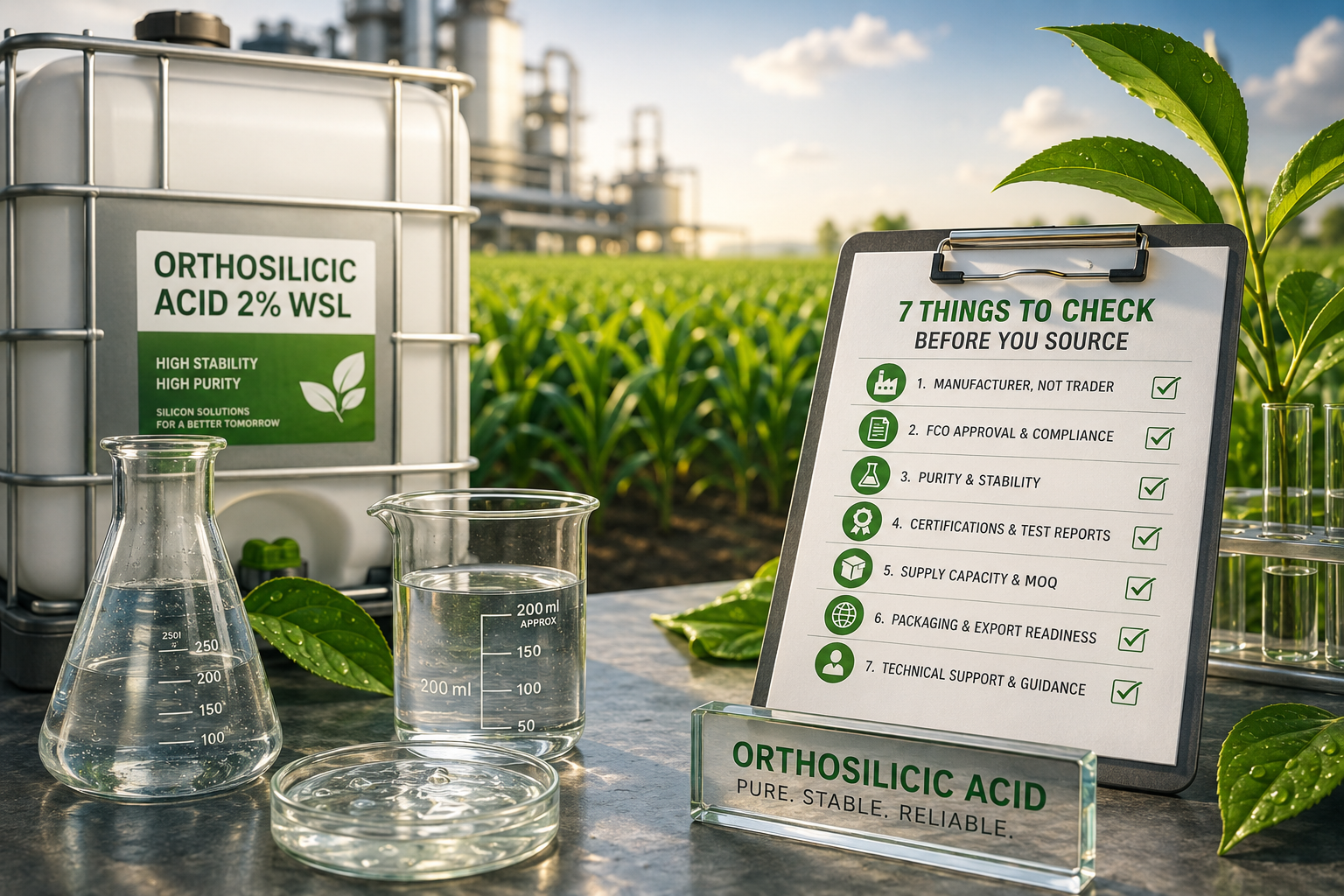
Orthosilicic Acid Manufacturer in India: 7 Things to Check Before You Source
India Has Hundreds of OSA Suppliers. Finding the Right One Is the Real Challenge.
A quick Google search for an orthosilicic acid manufacturer in India can leave you drowning in options. Everyone promises premium quality, competitive pricing, and bulk supply capabilities. But here's the uncomfortable truth: not every supplier selling Orthosilicic Acid (OSA) is actually manufacturing it.
And when you're sourcing a critical raw material for agrochemical products, foliar nutrition solutions, or silicon based fertilizers, choosing the wrong supplier can lead to formulation failures, regulatory headaches, and unhappy customers.
So before you send that purchase order, here's a practical checklist every procurement team and formulator should follow.
Manufacturing vs Trading
Imagine paying for a farm fresh mango only to discover it changed three warehouses before reaching you. The same thing happens in chemical sourcing.
Many companies market themselves as an orthosilicic acid supplier India while simply forwarding material from another manufacturer. This often means higher costs, inconsistent quality, and limited technical support.
When evaluating a supplier, ask:
• Do they have their own manufacturing facility?
• Can they provide production details?
• Do they offer direct technical support?
A genuine manufacturer usually has greater control over quality, production scheduling, and batch consistency.
Verify FCO Compliance Before You Buy
In the fertilizer and plant nutrition industry, compliance isn't a bonus, it's the entry ticket.
If you're sourcing FCO approved orthosilicic acid, always verify registration status and supporting documentation.
Ask suppliers for:
- FCO registration details
- Product approvals
- Regulatory compliance documents
- Latest certification records
A supplier unwilling to share compliance documentation should immediately raise red flags.
After all, regulatory surprises are rarely pleasant business surprises.
Purity & Stability of the OSA Formulation
Here's where many buyers get trapped.
A supplier may advertise orthosilicic acid 2% liquid formulation or OSA 2% WSL manufacturer capabilities. Sounds great on paper.
But Orthosilicic Acid is naturally unstable unless properly stabilized during formulation. If the formulation isn't properly stabilized, the active silicon can polymerize over time, reducing bioavailability and effectiveness.
That's why the question isn't simply:
"Do you sell 2% OSA?" It's: "How stable is your 2% OSA?"
When evaluating stabilised orthosilicic acid India suppliers, always ask for:
- Stability data
- Shelf-life reports
- Storage recommendations
- Batch consistency records
Because in silicon nutrition, stability is where performance begins.
Certifications: ISO, Lab Test Reports, COA
Would you board an aircraft that skipped its safety inspection?
Then don't purchase OSA without documentation.
A professional ISO certified chemical manufacturer should have no hesitation in sharing:
- Certificate of Analysis (COA)
- Lab test reports
- Quality specifications
- Purity data
Always verify the product specification through a Certificate of Analysis (COA), including active ingredient content, silicon concentration, pH, and other quality parameters.
Supply Capacity & MOQ
Every supplier looks impressive when you're ordering 50 liters.
The real test comes when you suddenly need 5,000 liters.
Before finalizing an OSA 2% WSL bulk supplier India, evaluate:
- Production capacity
- Monthly output
- Lead times
- Inventory management
- Minimum Order Quantity (MOQ)
The last thing a growing agrochemical brand needs is a supplier that becomes a bottleneck exactly when demand starts taking off.
Packaging, Export Readiness & Delivery Lead Time
International shipments don't care how good your product is.
If packaging, documentation, and logistics aren't aligned, delays become inevitable.
When working with an orthosilicic acid exporter India, verify:
- Export compliance support
- Packaging options
- Labeling capabilities
- Dangerous goods documentation (if applicable)
- Delivery scheduling
Reliable logistics can often be just as valuable as reliable chemistry.
Technical Support & Application Guidance
Here's a simple test. Ask your supplier a technical question. If the response sounds like it came from a brochure, you're likely talking to a trader.
A genuine manufacturer understands how ortho silicic acid for agrochemical manufacturing behaves across different systems and can guide you on:
- Application rates
- Compatibility
- Tank-mix behavior
- Formulation challenges
- Performance optimization
Sourcing OSA Isn't Just a Procurement Decision, It's a Formulation Quality Decision
Choosing the right orthosilicic acid manufacturer in India goes far beyond comparing prices on a spreadsheet.
Whether you're looking to buy orthosilicic acid bulk India, develop a new silicon nutrition product, or expand your agrochemical portfolio, the supplier you choose today can directly influence the performance of your products tomorrow.
Because in the world of OSA, the cheapest supplier is rarely the most valuable one but the right supplier can become a long-term competitive advantage.
At Fenton Chemicals, we focus on delivering consistent product quality, regulatory compliance, technical expertise, and dependable supply helping our partners build high performance agricultural solutions with confidence.
Trisiloxane vs Polysiloxane Adjuvants: Technical Differences Every Formulator Must Know
Trisiloxane vs Polysiloxane Adjuvants: Technical Differences Every Formulator Must Know.
Ever spent months perfecting a pesticide formulation, only to discover that the problem wasn't the active ingredient at all?
Welcome to one of agrochemical formulation's most frustrating realities: sometimes the chemistry that's supposed to help the product perform ends up being the factor that limits it.
When it comes to trisiloxane vs polysiloxane adjuvants, many formulators assume they're simply different versions of the same silicone technology. They aren't. One is engineered to spread a droplet across a leaf like wildfire, while the other is built to deliver stability and formulation robustness under demanding conditions.
That's why understanding the science behind these two silicone technologies isn't just useful. it's essential. Whether you're developing a next-generation herbicide, optimizing an EC/SC formulation, or searching for the ideal organosilicone adjuvant for pesticide formulation, knowing where trisiloxanes and polysiloxanes differ can save both development time and costly reformulation later.
What Is a Trisiloxane Adjuvant?
If conventional surfactants are the family sedan of spray technology, trisiloxane adjuvants are the Formula 1 race cars.
Built on a three-silicon backbone and commonly formulated as polyether modified trisiloxane, these advanced organosilicones are designed for one purpose: making spray droplets behave in ways ordinary surfactants simply can't.
Think about what usually happens when a pesticide droplet lands on a leaf. It beads up, sits awkwardly on the surface, and sometimes rolls right off. A trisiloxane changes the game completely.
This is why trisiloxanes are often called super spreading silicone surfactants. Instead of covering a tiny spot, a single droplet can spread into a thin film, maximizing contact with the target surface and improving active ingredient delivery.
For formulators, that's where the real magic happens:
- Ultra-low surface tension
- Exceptional contact angle reduction spray performance
- Rapid spreading on waxy and difficult-to-wet surfaces
- Enhanced stomatal penetration adjuvant capabilities
- Faster uptake of active ingredients
- Improved rainfastness adjuvant performance
What Is a Polysiloxane Adjuvant?
If trisiloxanes are the sprinters of the silicone world, polysiloxanes are the marathon runners.
Think of them as the calm engineer in the room. While everyone is talking about spreading speed, polysiloxanes are making sure the formulation remains stable on the shelf, performs predictably in the tank, and behaves consistently in the field.
That's why formulators often turn to a polysiloxane surfactant for EC SC formulation when product robustness matters just as much as spray performance.
Key advantages include:
- Reliable surface tension reduction
- Improved spray retention on crop surfaces
- Excellent formulation compatibility
- Better emulsification and dispersion properties
- Enhanced hydrolytic stability
- Strong performance across a wide range of formulation systems
Trisiloxane vs Polysiloxane: Head-to-Head Comparison
| Property | Trisiloxane Adjuvant | Polysiloxane Adjuvant |
| Silicone Structure | Three-silicon chain | Long silicone chain |
| Surface Tension Reduction | Extremely high | Moderate |
| Dynamic Surface Tension | Very low | Medium |
| Contact Angle Reduction Spray | Excellent | Good |
| Super Spreading Ability | Outstanding | Limited |
| Stomatal Penetration | Excellent | Moderate |
| Rainfastness Adjuvant Performance | Very High | Good |
| Tank Mix Adjuvant Capability | Excellent | Good |
| EC SC Formulation Compatibility | Moderate | Excellent |
| Hydrolysis Resistance | Lower | Higher |
| Spray Coverage | Maximum | Moderate |
| Formulation Stability | Moderate | High |
Hydrolysis: The Risk Formulators Often Miss
One of the most overlooked technical considerations when selecting a silicone adjuvant is hydrolysis.
Trisiloxane-based surfactants, particularly highly active polyether modified trisiloxane products, can be more susceptible to hydrolysis under extreme pH conditions. Over time, hydrolysis can alter molecular structure and impact performance.
This becomes especially important when developing:
- High-pH formulations
- Long shelf-life products
- Complex tank-mix systems
- Concentrated agrochemical formulations
Polysiloxane-based materials generally offer better hydrolytic stability, making them attractive for formulations that require extended storage or challenging chemical environments.
Formulator's Decision Guide
Choosing between trisiloxane and polysiloxane is not about identifying which technology is "better." The real question is: what performance objective are you trying to achieve?
Choose a trisiloxane adjuvant for herbicide formulation when your objective is:
- Maximum spreading
- Fast penetration
- Superior spray coverage
- Low-volume spraying
- Enhanced foliar uptake
- Premium field performance
Choose a polysiloxane surfactant for EC SC formulation when your objective is:
- Long-term formulation stability
- Better compatibility with formulation ingredients
- Improved hydrolysis resistance
- Controlled spreading behavior
- Enhanced shelf life
Conclusion
Great formulations aren't accidental. They're engineered, molecule by molecule. Whether you choose trisiloxane for maximum spreading or polysiloxane for long-term stability, the right adjuvant can turn a good formulation into a standout one.

What Is a Wetting Agent? Difference Between Wetter, Spreader & Sticker in Agrochemicals
What Is a Wetting Agent? Difference Between Wetter, Spreader & Sticker in Agrochemicals.
You did everything right, but the spray still failed. You sprayed correctly, the dosage was right, the timing was perfect. And yet, the pesticide didn’t work the way it should have. Sounds familiar? This is one of the most frustrating realities of the agriculture world today. When spray fails, we often blame the product. But in many cases, the real issue lies in how the product behaves after it leaves the nozzle.
Does it spread? Does it stick? Does it even reach where it needs to be? This is where adjuvants, especially a wetting agent in agriculture, quietly decides whether your spray works or wastes effort.
What Is a Wetting Agent?
A wetting agent in pesticides formulation is designed to solve a very basic problem, that water does not naturally spread well on plant surfaces.
Leave especially, the waxy ones, tend to repel water. Instead of spreading out, the spray forms droplets and just sits there limiting contact and reducing effectiveness.
A wetting agent agriculture solution turns it upside down.
It reduces surface tension of water, allowing the spray to spread evenly across the leaf. Think of it like turning water into a “flowing film” instead of stubborn droplets. Most wetting agents today are non-ironic wetting agents, which are widely compatible and stable in different formulations. The primary role as a Surface tension reducer pesticide additive is simple: Improve contact.
For foliar application, a wetting agent for foliar spray ensures the active ingredient actually touches enough of the plant surface to do it’s job.
What Is a Spreader?
If a wetting agent helps water start spreading, a spreader adjuvant in agriculture takes it further, ofcourse it maximizes coverage.
A spreader in agrochemicals doesn’t just reduce surface tension; it pushes the liquid outward, helping a single droplet cover a much larger surface area.
In simple terms,
- Wetting agent → helps droplets settle
- Silicone Super Spreader → makes them move and cover
If you’re looking for real spray coverage improvement, this is where spreaders play their role.
What Is a Sticker?
Now imagine you did everything right, the spray spread perfectly… but then it rained.
That’s where a sticker adjuvant in agriculture becomes important. A sticker’s job is not spreading. It’s staying.
Sometimes referred to as a chipko agent in agriculture, stickers ensure the formulation doesn’t wash off easily. They are especially useful in:
- Pre-rain spraying
- Long-lasting protection needs
A sticker for pesticide spray works like a protective glue keeping the formulation where it belongs.
Wetting Agent vs Spreader vs Sticker, What’s the Real Difference?
| Property | Wetting Agent | Spreader | Sticker |
| Primary Function | Reduces surface tension | Expands spray coverage | Locks spray on leaf surface |
| Key Benefit | Breaks water beading | Uniform leaf coverage | Rainfastness, adhesion |
| Active Chemistry | Non-ionic surfactant | Organosilicone / Trisiloxane | Polymer / Resin |
| Best Used For | Waxy leaf resistance | Maximum contact & penetration | Pre-rain application |
| Can It Penetrate? | Partial | Yes, deep penetration | No, surface level only |
Choosing the Right Adjuvant (Without Overcomplicating It)
You don’t always need all three. The trick is knowing when to use what.
- If water is not spreading → use a wetting agent
- If coverage is poor → go for a spreader
- If rain or wash-off is a concern → add a sticker
In many real-world cases, farmers either skip adjuvants completely or overdose them, expecting better results. Both are mistakes.
Common Mistakes That Reduce Efficacy
Some of the most common pesticide spray mistakes are surprisingly basic:
- Assuming higher dosage = better results
- Ignoring surfactant compatibility in tank mix
- Using random adjuvants without understanding their role
- Overusing surfactants, leading to leaf burn or poor performance
How Silicon Super Spreaders Change the Game
This is where things get very interesting.
A silicon super spreader doesn’t just act as a single-function adjuvant. It combines wetting and spreading or sometimes even outperforming traditional systems.
These trisiloxane adjuvants act as powerful silicone surfactants in agriculture, delivering:
- Rapid spreading
- Enhanced penetration
- Lower dosage requirements
Conclusion
At first glance, wetting agents, spreaders, and stickers might seem like minor add-ons.
But in reality, they decide whether your pesticide works at full potential—or falls short.
Because spraying isn’t just about what you apply.
It’s about how it behaves once it reaches the plant.
And getting that part right?
That’s where the real difference shows.

Oil Emulsifiers in Agriculture: Improving Stability and Spray Performance
Oil Emulsifiers in Agriculture: Improving Stability and Spray Performance
Problem Scenario Opener
A formulation may look perfectly stable inside a production facility and still fail once it reaches actual field conditions.
That happens more often than most people think.
A pesticide gets diluted inside the spray tank, temperatures shift during application, or water quality changes from one location to another. Suddenly, the formulation separates, spray coverage becomes uneven, and overall performance drops. In many cases, the active ingredient is not really the problem. The formulation system around it is.
This is exactly why oil emulsifiers agriculture applications have become much more important in modern agrochemical manufacturing. Companies are no longer focusing only on chemical strength. They’re paying closer attention to formulation stability, spray consistency, and long-term field performance, too.
The Root Cause: Why Formulations Fail in the Field
A lot of agricultural formulations struggle because oil and water naturally resist mixing together. That creates instability inside the spray solution, especially under changing environmental conditions.
An emulsifiable concentrate (EC) formulation, for example, depends heavily on proper emulsification behaviour. Without the right balance, ingredients can separate too quickly during storage or application.
Field conditions make the problem worse. Heat, agitation, water hardness, and transport conditions all affect the emulsion stability that pesticide systems rely on. Sometimes the formulation appears stable initially, but starts breaking down after dilution inside the spray tank.
Another issue is compatibility. Modern formulations often combine multiple ingredients, including fertilisers, herbicides, and adjuvants. Without proper tank mix compatibility adjuvants, performance becomes inconsistent very quickly.
This is where formulation chemistry becomes more technical than people expect.
The Solution: How Oil Emulsifiers Restore Control
Oil emulsifiers help stabilise formulations by improving how oil-based and water-based ingredients interact with each other. Instead of separating rapidly, the mixture remains more uniform during storage, dilution, and application.
That stability directly affects the spray performance that agricultural products depend on.
In many formulations, non-ionic surfactants used in agricultural systems are added to improve spreading, wetting, and dispersion quality. These surfactants also help droplets distribute more evenly across plant surfaces during spraying.
At the same time, agricultural surfactant herbicide formulations can improve absorption and reduce inconsistency during application. The result is usually better formulation behaviour under real working conditions rather than just inside controlled environments.
And honestly, that’s where the difference starts becoming noticeable.
Where the Real Impact Happens: Three Critical Roles
The first major role is formulation stability.
A good herbicide formulation stabiliser helps maintain consistency during storage and transport. That becomes especially important in large-scale agricultural operations where products may remain stored for longer periods before use.
The second role involves spray quality itself.
Droplet behaviour matters more than many people realise. Better droplet uniformity spray nozzles produce can improve surface coverage and reduce wasted product during application. Stable emulsifier systems help maintain more consistent spray distribution across crops.
The third role is drift management.
Certain spray adjuvants and drift reduction systems are designed to minimise off-target movement during spraying. That not only improves application efficiency but also helps reduce product loss under windy field conditions.
These smaller formulation adjustments can have a surprisingly large operational impact.
Real Applications: Where This Matters Most
Oil emulsifier systems are widely used across herbicides, fungicides, insecticides, suspension concentrates, and liquid agricultural blends.
They become especially important in formulations exposed to variable field conditions where spray consistency and stability directly affect performance outcomes.
Large-scale spraying operations often depend on stable emulsification because inconsistent formulations can create equipment issues, uneven coverage, or reduced treatment efficiency. In precision agriculture applications, even small formulation inconsistencies become more noticeable.
That’s one reason emulsifier technology continues evolving alongside modern agricultural chemistry.
The Formulation Decision: Why Emulsifier Selection Matters
Not every emulsifier performs the same way across every formulation.
Selection depends on multiple factors, including active ingredient compatibility, storage conditions, dilution behaviour, and application requirements. A system that works well in one emulsifiable concentrate (EC) product may not perform properly in another.
Conclusion
Modern agricultural formulations are expected to do far more than simply carry active ingredients. They need to remain stable, spray evenly, perform consistently, and adapt to changing field conditions.
That’s why oil emulsifiers used in agricultural systems are becoming increasingly important across industrial formulation chemistry. From improving emulsion stability, pesticide formulations rely on to supporting better spray performance, agriculture applications require, emulsifier technology now plays a much larger role in overall product performance than it did a few years ago.
Explore Fenton Chemicals’ range of advanced agro emulsifiers and surfactant technologies designed for stable agricultural formulations and improved spray performance.

How Silicon Super Spreaders Improve Pesticide and Fertilizer Efficiency
How Silicon Super Spreaders Improve Pesticide and Fertilizer Efficiency
In modern agriculture, profitability isn't about what you apply, it's all about how every drop performs. With tightening margins and rising input costs, the focus has tremendously shifted from quantity to performance.
Today, the difference between an average spray and a high impact application often comes down to formulation science, specifically how effectively active ingredients reach where they need to act.
That shift in thinking is what has put silicone spreaders firmly in the spotlight.
Why Efficiency Matters in Modern Agriculture
As with many inflation-affected products, pesticide and fertilizers prices are steadily rising. Growers and formulators alike are under pressure to extract maximum value from each application.
Modern efficiency isn’t about fixing spray problems, it’s about input optimisation:
- Precise delivery, not over application
- Maximum active ingredient utilisation
- Fewer re-spray across the spray cycle.
Achieving more with less has become a practical necessity, not an option.
The Science That Drives Efficiency Enhancement
Here’s where things get interesting.
At the heart of advanced silicone spreaders lies Organosilicone Polyether Trisiloxane chemistry. This molecule behaves very differently from conventional surfactants.
Unlike traditional surfactants that plateau at moderate surface tension reduction, organosilicone adjuvants achieve ultra‑low surface tension, allowing spray solutions to behave more like flowing film than a droplet.
What does that unlock?
- Ultra-low surface tension
- Stomal infiltration
- Cuticle penetration.
Instead of sitting on the leaf, the spray becomes part of the plant’s internal story.
Performance Impact on Pesticide Efficiency
Here we’ll talk about smarter biology
Key performance advantages include:
- Increased bioavailability of active ingredients
- Improved pest contact, reducing the need for re‑application
- Lower effective dosage requirements
- Enhanced performance of systemic pesticides through faster absorption
And the Result? It’s consistent control with fewer spray intervention.
Game‑Changing Impact on Fertilizer Efficiency
This is where silicone adjuvant truly stand apart, and where they are still underutilized.
Following are the results when liquid silicon fertilizer has been paired with silicon adjuvants :
- Nutrient uptake kinetics
- Retention of nutrients on leaf surfaces
- Movement of nutrients into plant tissue ie. powerful synergy between silicone adjuvant + nutrients
Also, one important thing, there's a strong synergistic effect: nutrients delivered alongside agricultural silicone surfactants show higher efficiency due to faster and deeper penetration meaning less nutrient loss and better plant response.
Conventional Surfactants Vs Silicone Super Spreader
| Factor | Conventional Surfactant | Silicone Super Spreader |
| Surface tension | Moderate | Ultra‑low |
| Coverage | Partial | Complete |
| Dosage | Higher | Very low |
| Penetration | Limited | Deep |
This isn’t just an upgrade, it’s a different league.
ROI: The Cost–Benefit Reality
Let’s talk outcomes now:
- Reduced agrochemical and fertilizer usage
- Fewer spray cycles
- Improved yield consistency
- Lower cost per acre
Thus, Silicone spreaders don’t add cost, they optimize existing investment.
Application Versatility Across Programs
A single agricultural silicone surfactant can enhance:
- Herbicides, fungicides, insecticides
- Foliar nutrients and micronutrient blends
This versatility makes it quite an MVP in modern spray programs.
Where Silicone Super Spreaders Deliver Maximum Value
- Herbicides → improved weed interaction
- Fungicides → deeper leaf protection
- Insecticides → superior pest contact
- Foliar fertilisers → enhanced nutrient uptake
No fluff, just functional wins.
Choosing the Right Silicone Spreader
Not all silicone spreaders behave the same . Performance depends on:
- Formulation compatibility
- Crop‑specific requirements
- Consistent quality and technical support
That’s why sourcing from a trusted speciality chemical manufacturer in India makes a measurable difference in field reliability.
Smart Usage Practices
- Use optimized, low‑dose rates
- Follow correct tank‑mixing order
- Apply during optimal spray windows
Precision always amplifies performance.
Conclusion: Efficiency Is Where Profit Lives
In today’s agriculture, efficiency defines profitability. Silicone Super Spreaders are no longer optional add‑ons they are strategic enablers that help every pesticide and fertilizer perform to its full potential.
For consistent results and formulation excellence, partnering with a trusted manufacturer like Fenton Chemical ensures your chemistry works harder without costing more.